
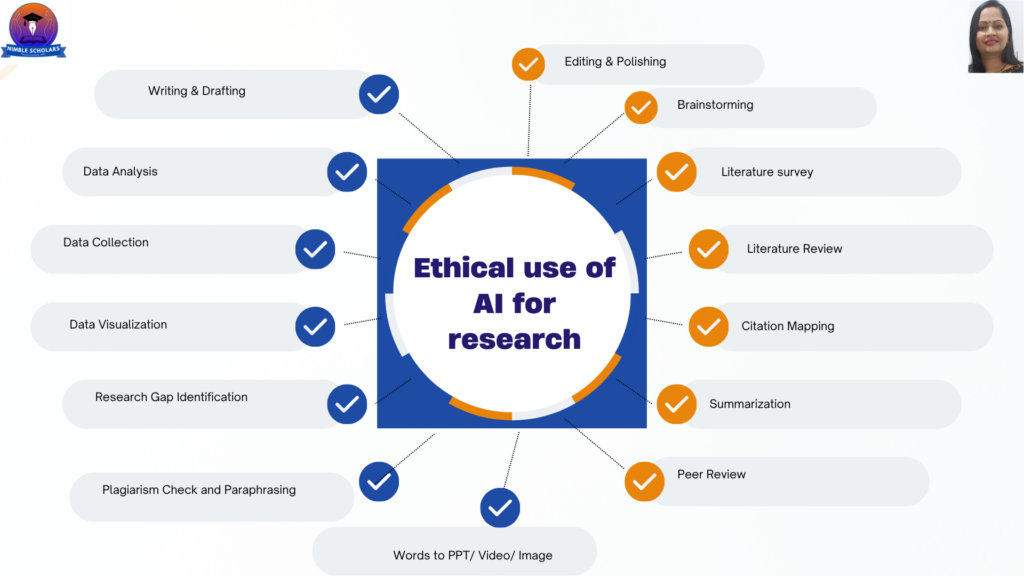
Ethical Applications of AI Across the Research Process
AI should be viewed as a research assistant—not a researcher. It can automate repetitive tasks, organize information, and improve writing quality, but it cannot replace human creativity, critical thinking, or scientific judgment.
This blog explores how AI can be used ethically throughout the research lifecycle.
1. Brainstorming Research Ideas
Every research project begins with a question. AI tools can help researchers generate ideas, identify emerging trends, and refine research questions.
AI can help:
- Suggest research topics
- Generate research questions
- Create study objectives
- Develop conceptual frameworks
Recommended Tools
- ChatGPT
- Gemini
- Claude
Ethical Practice
Use AI-generated ideas as inspiration rather than adopting them without reflection. The originality of the research question should come from the researcher.
2. Literature Survey
Finding relevant literature often requires searching hundreds of papers.
AI-powered search tools can quickly identify important publications and recommend related studies.
AI can help:
- Find relevant research papers
- Discover influential studies
- Recommend related articles
- Identify recent publications
Recommended Tools
- Scopus AI
- Semantic Scholar
Ethical Practice
Always read the original papers instead of relying solely on AI-generated summaries.
3. Literature Review
Writing a literature review is one of the most time-consuming parts of research.
Generative AI can summarize multiple papers and identify common themes.
AI can help:
- Summarize research papers
- Compare findings
- Organize literature by themes
- Identify research gaps
Recommended Tools
- SciSpace
- Elicit
- Consensus
Ethical Practice
Researchers must verify summaries against the original publications and avoid copying AI-generated text directly.
4. Citation Mapping
Understanding how research papers connect is important for identifying influential work.
AI-powered citation mapping tools visualize relationships among publications.
AI can help:
- Identify highly cited papers
- Explore citation networks
- Discover foundational studies
Recommended Tools
- Connected Papers
- ResearchRabbit
- Semantic Scholar
Ethical Practice
Always ensure cited papers are relevant and have been read before including them in your manuscript.
5. Summarization and Chat with PDF
Reading lengthy research papers can be time-consuming, especially during a literature review. AI-powered Chat with PDF tools enable researchers to upload a paper, ask questions in natural language, and quickly extract key information without reading the entire document first.
AI can help:
- Summarize research papers in simple language.
- Explain complex concepts, methods, and results.
- Extract key findings and conclusions.
- Answer questions about the paper (e.g., What is the methodology?, What are the limitations?).
- Compare multiple research papers.
Recommended Tools
- SciSpace – Chat with PDFs, explain technical concepts, summarize research papers.
- ChatGPT – Summarize and explain uploaded documents (where supported).
- Claude – Analyze and summarize long research papers.
Ethical Practice
AI-generated summaries should be used as a starting point, not a substitute for reading the original paper. Researchers should verify key findings, interpret results in context, and avoid citing information solely from AI-generated summaries.
6. Research Gap Identification
One of AI’s greatest strengths is synthesizing large volumes of literature to identify underexplored areas.
AI can help:
- Compare previous studies
- Highlight limitations
- Suggest future research directions
Recommended Tools
Scispace
AnswerThis
Ethical Practice
AI can suggest potential gaps, but researchers should validate whether those gaps are genuine and significant.
7. Data Collection
AI simplifies data collection by automating surveys, interview transcription, and field data management.
Recommended Tools
- Qualtrics
- REDCap
- KoBoToolbox
- SurveyMonkey
Ethical Practice
Protect participant privacy and avoid uploading confidential or sensitive data to public AI platforms.
8. Data Analysis
AI can support both quantitative and qualitative data analysis.
AI can help:
- Statistical analysis
- Pattern recognition
- Text analysis
- Coding assistance
Recommended Tools
- JULIUS AI
- JASP AI,
- R
- NVivo AI
Ethical Practice
Researchers should understand the analytical methods used and verify AI-generated interpretations.
9. Data Visualization
Well-designed visualizations improve the communication of research findings.
AI can help:
- Generate graphs
- Design figures
- Create infographics
- Draw charts
Recommended Tools
- Power BI
- Flourish
- biorender
- EdrawMax
Ethical Practice
Ensure that visualizations accurately represent the data without exaggerating or misrepresenting findings.
10. Writing and Drafting
Generative AI has become a valuable assistant for academic writing.
AI can help:
- Draft introductions
- Improve grammar
- Suggest headings
- Simplify complex language
Recommended Tools
- Jenni AI
- Writefull
- Paperpal
Ethical Practice
Authors must review, edit, and take responsibility for all AI-assisted writing. AI should never replace scientific reasoning.
11. Editing and Polishing
AI improves readability and language quality.
Recommended Tools
- Grammarly
- Paperpal
- Trinka AI
Ethical Practice
Editing should improve clarity without changing the intended scientific meaning.
12. Plagiarism Check and Paraphrasing
AI can help identify overlapping text and improve wording.
Recommended Tools
- Turnitin
- iThenticate
- Paperpal
Ethical Practice
Paraphrasing should preserve the original meaning while ensuring proper citation. AI must not be used to disguise plagiarism.
13. Journal Selection
Selecting the right journal increases the likelihood of successful publication.
AI can help:
- Match manuscript topics
- Recommend journals
- Compare impact metrics
Recommended Tools
- Elsevier Journal Finder
- Springer Nature Journal Suggester
- JANE
Ethical Practice
Choose journals based on scope, quality, and relevance—not solely on impact factor or AI recommendations.
14. Converting Research into Different Formats
Researchers often need to present their work in multiple formats.
AI can assist in transforming content into presentations, posters, videos, or educational materials.
AI can help:
- Generate PowerPoint presentations
- Design posters
- Create educational videos
- Produce visual summaries
Recommended Tools
- Gamma
- Scispace
- Beautiful.ai
Ethical Practice
Review all generated content to ensure scientific accuracy and consistency.
15. Peer Review Support
Although AI cannot replace peer reviewers, it can help identify areas for improvement before submission.
AI can help:
- Improve clarity
- Detect inconsistencies
- Suggest revisions
- Check grammar
Ethical Practice
Peer review requires expert judgment. AI should support—but never replace—the independent evaluation of scientific work.
Best Practices for Responsible Researchers
To use AI ethically, researchers should follow these guiding principles:
- Use AI as an assistant, not an author.
- Verify all facts, references, and citations.
- Protect confidential and sensitive research data.
- Disclose AI use when required by journals or institutions.
- Avoid plagiarism and maintain originality.
- Review AI outputs for bias and fairness.
- Follow publisher and institutional AI policies.
- Accept full responsibility for the final manuscript.