
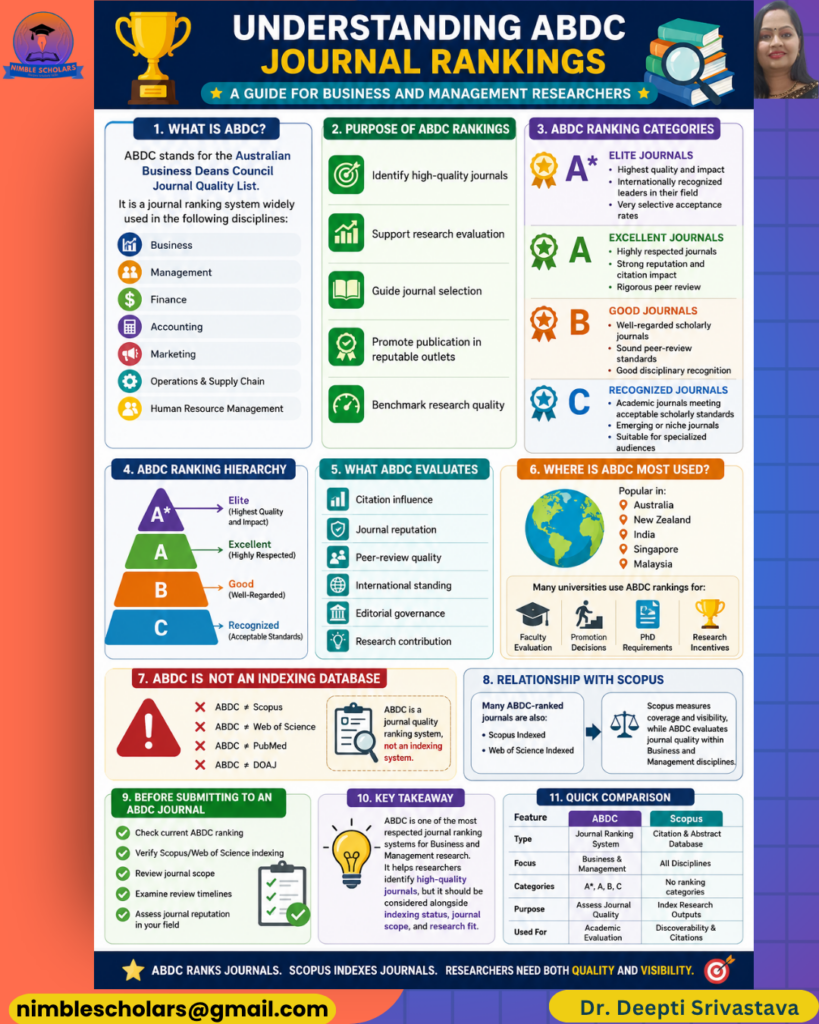
Publishing research is about more than simply getting accepted by a journal; it’s about choosing the right platform that maximizes your work’s credibility, visibility, and academic impact. For researchers in Business, Management, Finance, Marketing, HR, and related disciplines, one of the most widely recognized quality benchmarks is the ABDC Journal Quality List.
If you’re planning your next publication, here’s everything you need to know about ABDC rankings and how they can guide your research journey.
What is the ABDC Journal Quality List?
The Australian Business Deans Council (ABDC) Journal Quality List is a journal ranking system designed to evaluate the quality and reputation of academic journals in business and management-related disciplines.
It is extensively used by researchers, universities, and academic institutions across fields such as:
- Business
- Management
- Finance
- Accounting
- Marketing
- Operations & Supply Chain Management
- Human Resource Management
Rather than serving as an indexing database, the ABDC list provides a structured way to assess journal quality and academic reputation.
Why Are ABDC Journal Rankings Important?
1. Identify High-Quality Journals: The rankings highlight journals that maintain strong editorial standards and publish impactful research.
2. Support Academic Evaluation: Many universities and institutions use ABDC rankings during faculty evaluations, promotions, tenure decisions, and research assessments.
3. Simplify Journal Selection: Instead of navigating thousands of journals, researchers can prioritize reputable publication venues aligned with their research goals.
4. Encourage Quality Publications: Publishing in highly ranked journals strengthens academic profiles and increases professional credibility.
5. Benchmark Research Excellence: ABDC rankings provide a common standard for evaluating research quality across institutions.
Understanding ABDC Journal Quality List Ranking Categories
The ABDC Journal Quality List classifies journals into four quality tiers.
1. A* (Elite Journals)
These represent the highest-quality journals with:
- Exceptional academic impact
- International recognition
- Highly selective acceptance rates
- Leadership within their disciplines
Publishing in an A* journal often represents a significant academic achievement.
2. A (Excellent Journals)
These journals are:
- Highly respected
- Known for rigorous peer review
- Frequently cited
- Well-established within their research communities
They maintain consistently high publication standards.
3. B (Good Journals)
B-ranked journals are reputable scholarly publications that:
- Follow sound peer-review practices
- Maintain good editorial quality
- Enjoy solid disciplinary recognition
They offer valuable publication opportunities, particularly for emerging researchers.
4. C (Recognized Journals)
These journals:
- Meet acceptable scholarly standards
- Often serve specialized research communities
- May be newer or more niche publications
While they carry lower rankings, they still contribute meaningfully to academic discourse.
The ABDC Journal Ranking Hierarchy
The ranking structure follows a simple hierarchy:
A* → Elite quality and impact
A → Excellent and highly respected
B → Good scholarly reputation
C → Recognized academic standards
As researchers progress in their careers, many aim to publish in higher-ranked journals while ensuring alignment with their research scope.
What Does ABDC Journal Ranking Evaluate?
ABDC rankings consider several indicators of journal quality, including:
- Citation influence
- Journal reputation
- Peer-review standards
- International standing
- Editorial governance
- Overall research contribution
These criteria help distinguish journals that consistently publish rigorous and influential research.
Where Are ABDC Journal Rankings Most Commonly Used?
Although developed in Australia, the ABDC ranking system has gained international recognition.
It is widely referenced in countries including:
- Australia
- New Zealand
- India
- Singapore
- Malaysia
Many universities use ABDC rankings for:
- Faculty performance evaluations
- Promotion and tenure decisions
- PhD publication requirements
- Research incentive programs
ABDC Journal Quality List Is a Ranking System-Not an Indexing Database
One of the most common misconceptions among researchers is confusing ABDC with indexing databases.
ABDC does not index journals.
Instead, it evaluates and ranks journals based on quality.
This means:
- ABDC ≠ Scopus
- ABDC ≠ Web of Science
- ABDC ≠ PubMed
- ABDDC ≠ DOAJ
A journal may be indexed in Scopus or Web of Science while also receiving an ABDC ranking. These systems serve different purposes.
ABDC and Scopus: What’s the Difference?
Although often mentioned together, ABDC and Scopus evaluate journals differently.
| ABDC | Scopus |
|---|---|
| Journal ranking system | Citation and abstract database |
| Focuses on journal quality | Focuses on indexing and visibility |
| Used primarily in Business & Management | Covers all disciplines |
| Categories: A*, A, B, C | No ranking categories |
| Supports research quality assessment | Enhances discoverability and citation tracking |
Many highly ranked ABDC journals are also indexed in Scopus, making them attractive publication choices for researchers seeking both quality and visibility.
Before Submitting to an ABDC Journal
Before sending your manuscript, take time to evaluate the journal carefully.
A practical checklist includes:
- Confirm the journal’s current ABDC ranking.
- Verify whether it is indexed in Scopus or Web of Science.
- Ensure your manuscript aligns with the journal’s aims and scope.
- Review average peer-review and publication timelines.
- Examine the journal’s reputation within your research field.
Careful journal selection increases the likelihood of successful publication.
Finding the right journal is just as important as writing a great paper. Make informed publication decisions that maximize the quality, visibility, and impact of your research.
📧 For professional journal selection assistance, contact us at: nimblescholars@gmail.com